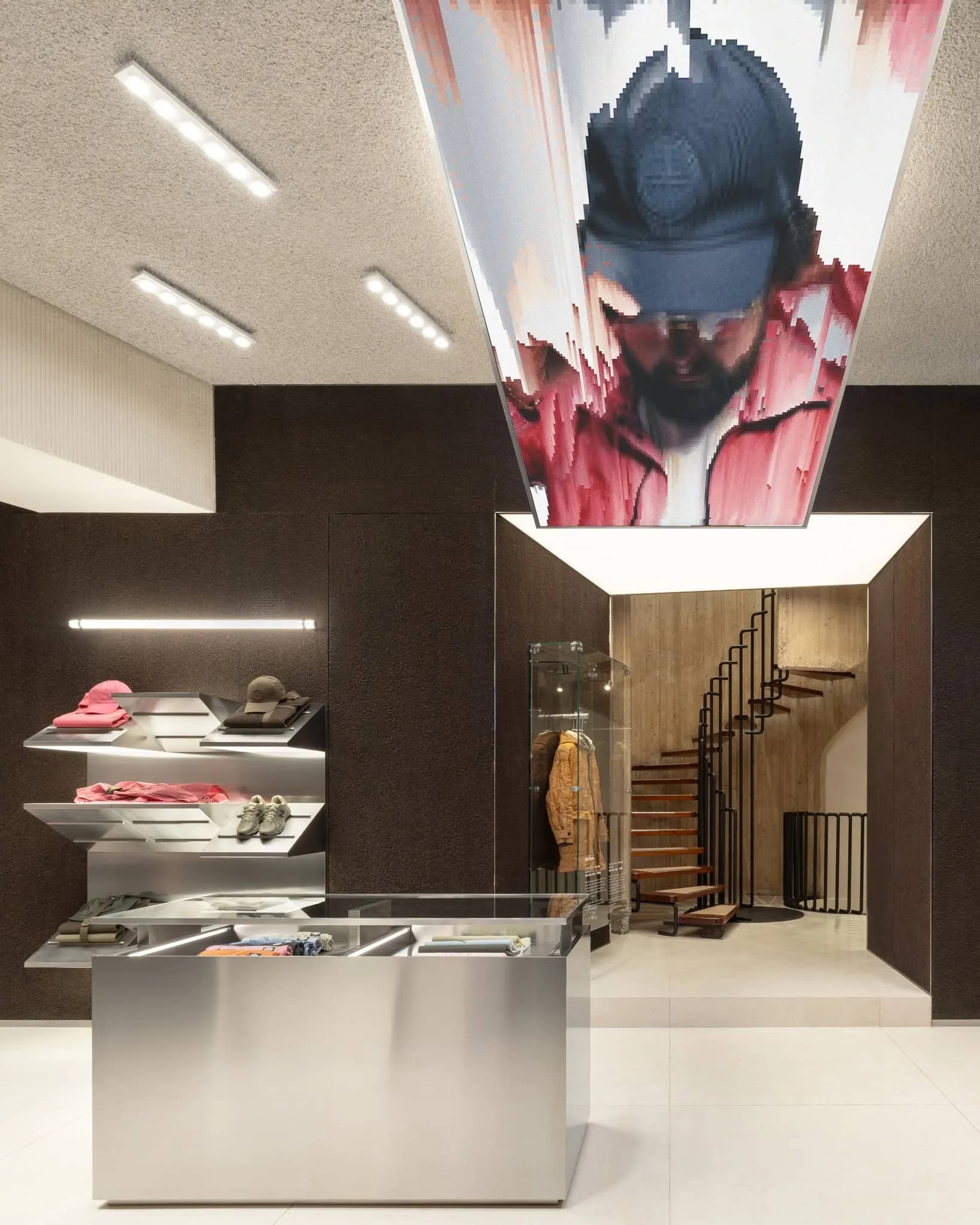
Stone Island Introduces the Hyperblock at Its Rome Store
Stone Island Introduces the Hyperblock at Its Rome Store
 Instagram
Stone Island Introduces the Hyperblock at Its Rome Store
The post details a custom sculptural intervention — the Hyperblock — designed to unify a historic palazzo’s fragmented rooms into a continuous retail flow. A display trunk is singled out among custom elements, foregrounding spatial design over product density.
Why it matters
Stone Island treats this Rome opening as a convergence of architecture, product, and community, refusing the passive neutrality of a standard boutique. Placing a monolithic, contemporary insertion inside a preserved historic building mirrors the brand’s own logic: technical innovation anchored by material heritage. The Hyperblock functions less as a fixture and more as an organizing principle, suggesting that the store is designed to guide movement and gathering rather than merely merchandise. For a brand with deep subcultural roots, a physical space that stages congregation — not just transaction — can strengthen offline community ties that digital channels cannot replicate alone. This also arrives as luxury retail increasingly invests in flagship environments that behave like cultural institutions, using architectural authorship to deepen brand equity beyond seasonal collections. The Rome store hints that Stone Island may be developing a repeatable spatial language, not a one-off expression; strategists should monitor whether this sculptural vocabulary surfaces in forthcoming locations.
VQ Score
Likes
Comments